Star Wars™: Galaxy of Heroes
- 4.1
- Rating
- 50.00M
- Installs
- Free
- Price

 Analysis by App-foxy
Star Wars™: Galaxy of Heroes is the kind of role-playing game I can open for a short session and still feel that I have made useful progress. Instead of controlling one hero through a long adventure, I build a collection of familiar characters, improve their abilities, and send teams into turn-based battles. That structure makes it easy to understand at first, but the deeper I go, the more important team choices, upgrade priorities, and patience become.
Developed by ELECTRONIC ARTS, the game brings together characters associated with stories such as The Mandalorian and The Bad Batch, alongside other recognizable parts of the Star Wars universe. I found the appeal less about one continuous campaign and more about gradually assembling squads that work well together. It is a collection-focused game with role-playing progression, tactical combat, and a steady stream of decisions about where to spend limited resources.
The game is free to install and is rated Everyone 10+. It has attracted more than 50 million installs, with a 4.0 average from roughly 1.8 million ratings and about 175 thousand written reviews. Those figures suggest a large, established audience, but they do not remove the need to decide whether its long-term style suits you. This is not a quick premium adventure that I finish and put away; it is a persistent game built around returning regularly.
You May Also Like

 Pandora - Music & Podcasts
Pandora’s Music Is Easy to Start, but Harder to Recover
Pandora’s strength is its low-effort path from a seed to a station. Its weak spot is how much confidence it asks you to place in connection, setup, and quiet recovery.

 AccuWeather: Weather Radar
AccuWeather Review: A Quick, Clear Forecast for Everyday Decisions
For everyday plans, the best forecast is the one you can understand quickly. AccuWeather makes rain timing, radar, and local conditions easy to act on, with a few trade-offs.

 Hill Climb Racing
Why Hill Climb Racing Still Turns Crashes Into One More Run
A tiny car, a bumpy hill and one more upgrade: Hill Climb Racing keeps resurfacing because its simple chaos makes every near-miss feel personal.

 AliExpress - Shopping App
AliExpress Makes Global Shopping Feel Personal, but Shoppers Bear the Risk
AliExpress turns a global marketplace into a pocket-sized discovery engine. Its reach is useful, its shopping loop compelling, and its trade-offs easy to miss.

 Lords Mobile: Kingdom Wars
Lords Mobile Is a Kingdom-Building Routine, Not a Quick Match
A case-by-case verdict on the building, battles, device demands, and social commitments that make Lords Mobile rewarding for some players and exhausting for others.

 PDF Scanner app - TapScanner
TapScanner Makes Paperwork Easier to Capture, Check, and Share
TapScanner makes scanning with a phone feel less like a rescue operation and more like a dependable step in getting work done. Its capture tools are useful, though not flawless.
More From Our News Desk
View All News


How the free model affects the value
The most important cost detail is straightforward: the game can be downloaded and played without an upfront purchase. That gives curious players a sensible way to test the combat, collection loop, and progression before spending anything. In my view, this is the strongest part of its value proposition, because the opening experience lets you discover whether managing squads is enjoyable before asking you to make a financial commitment.
Optional in-app purchases range from $0.99 to $99.99 per item. I would treat that range as a reason to set a personal spending limit before getting deeply involved, especially if the game becomes part of a daily routine. Free access and paid value are separate questions here: you can begin at no cost, while purchases may change the speed or convenience of progression. They do not automatically make the underlying battles more enjoyable for someone who dislikes collection-based games.
I also appreciate that the free route is useful for evaluation rather than merely being a brief sample. You can learn whether turn-based battles hold your attention, whether collecting characters feels rewarding, and whether the repeated upgrade decisions fit your available time. My advice is to play normally first and resist buying anything simply because a new character or upgrade creates urgency. The game is much easier to judge when your opinion is based on its systems rather than on a purchase made during an exciting moment.
The current Android version is 0.38.1947517, and it requires Android 7.0 or later. That makes checking the operating system worthwhile before planning to play on an older device. I would also leave room for the game to occupy a regular place in your routine, because its value comes from continued collection and improvement rather than a single self-contained session.
The loop that keeps me returning
My usual session starts with a practical question: which team deserves attention today? I may improve a character who is close to becoming useful, prepare a squad for a difficult battle, or simply clear a few available activities. That small choice matters because resources are easier to waste than they first appear. A broad collection is tempting, but spreading upgrades across too many characters can leave several teams feeling unfinished.
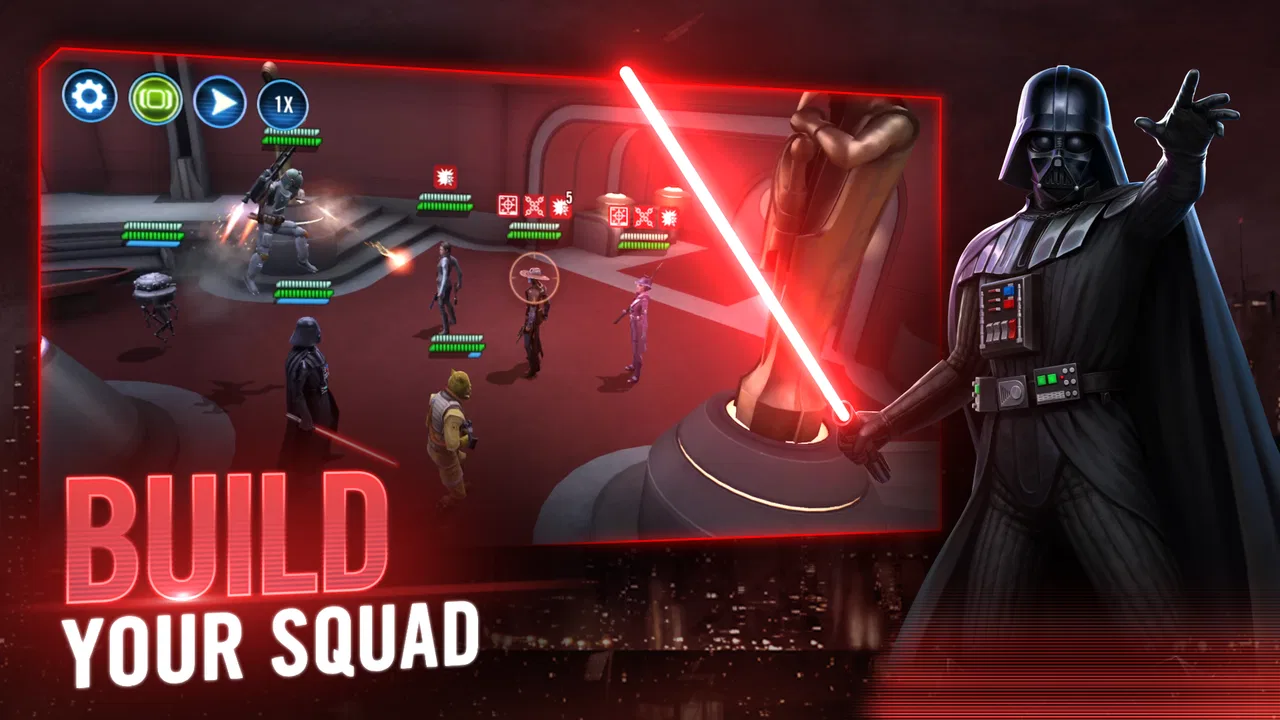
The combat itself is accessible. Battles are turn-based, so I have time to inspect the situation and choose an ability instead of relying on fast reflexes. The interesting decisions come from matching characters to a purpose, timing special actions, and recognizing when a battle is better approached with a different squad. A powerful individual is not always the best answer if the rest of the team does not support that character.
One useful habit is to keep notes on which characters already perform well together before spending upgrade materials. I do not need a complicated spreadsheet; even remembering a few reliable combinations helps prevent impulsive investments. This is one of the less obvious lessons of the game: collecting more characters is not the same as building a stronger roster. A smaller group with coherent roles can be more useful than a large group that has received scattered attention.
The Star Wars setting also gives the collection loop an emotional advantage. Unlocking or improving a character I recognize feels more personal than upgrading a nameless unit. That connection can make routine battles feel worthwhile. At the same time, players who are not attached to the franchise may notice the repetition sooner, because the story familiarity is one of the main reasons to care about the long-term roster.
Practical play for short and long sessions
For a busy weekday, I would use the game as a compact routine rather than trying to complete everything. I might check progress, spend energy or available attempts carefully, and stop after handling the tasks that support my current team. This works well during a commute break or while waiting for an appointment, provided I am comfortable with a game that rewards regular attention more than occasional marathon play.
On a quieter weekend, I can make more deliberate choices: examine which squad is underperforming, compare possible upgrades, and retry a battle with a different approach. The difference between these sessions is important. Short play is good for maintenance, while longer play is better for planning. If you only have time to open the game once every few weeks, its gradual progression may feel less satisfying than a traditional role-playing game designed around a finished story.
A second practical tip is to avoid treating every loss as a signal that the answer is simply more power. Sometimes the real problem is team composition or the order in which abilities are used. I found that pausing to identify the first point where a battle goes wrong teaches me more than repeatedly entering the same fight without changing anything. That approach also reduces the temptation to spend money just to force progress.
The game is most comfortable for players who enjoy planning around limitations. You will often have reasons to choose one upgrade over another, and those choices become more meaningful when you are not trying to improve everyone at once. If you prefer a role-playing game where every new character immediately feels complete, this structure may seem restrictive rather than strategic.
Where the experience becomes demanding
The main friction is the long-term progression model. Early victories can feel generous, but the collection and improvement process naturally becomes more demanding as expectations rise. I enjoy that gradual curve when I am in the mood for a project, yet I can also see why someone might find it slow. The game asks for patience, repeated engagement, and willingness to accept that a desired goal may take time.
Purchases are another trade-off. Because the game is free to start, optional spending can look harmless in isolation, especially when individual items begin at a low price. The broader purchase range means the total cost can become much more significant if I stop evaluating each payment as a separate decision. I would not recommend spending to anyone who feels pressured by a deadline, a difficult battle, or the desire to catch up with other players.
There is also a mental cost to maintaining a large roster. More characters create more possibilities, but they also create more upgrade decisions. I sometimes find that the game is asking me to manage the collection rather than simply enjoy the Star Wars setting. That is not a flaw for a player who likes optimization; it is a clear warning for anyone seeking a relaxed, story-first adventure.
Another limitation is that the best use of a new character depends on the rest of the roster. A character can be appealing on its own and still fail to solve the problem I am facing if the surrounding team is weak or poorly developed. This makes the game more strategic than a simple popularity contest, but it also means that collecting a favorite does not guarantee immediate usefulness.
How it compares with other role-playing choices
Compared with a conventional single-player role-playing game, this one offers less of a clean beginning-to-end journey and more of an ongoing account to develop. I would choose it when I want recurring battles, collection goals, and the pleasure of improving teams over time. I would choose a traditional story-driven game instead when I want a focused plot, a clear ending, or the freedom to progress without checking back regularly.
Compared with a fully premium mobile game, the free entry is a major advantage for testing the experience. I do not have to decide immediately whether the complete package is worth a fixed purchase. The trade-off is that the free model is connected to a progression structure that can make patience important. A paid game may offer a simpler relationship with content, while this title offers a lower barrier to entry and a more persistent collection journey.
Compared with faster action role-playing games, the turn-based format is calmer and more deliberate. I can think about ability order and team fit rather than depending on reaction speed. That makes it a good choice for touch-screen play in short bursts, but players who want constant movement or direct control may find the battles too measured.
Its strongest comparison point is the licensed setting. Many collection games rely entirely on mechanics to create attachment, while this one benefits from recognizable Star Wars characters and eras. That does not replace good progression design, but it gives each roster decision extra meaning for fans. If the franchise does not matter to you, another role-playing game with a more original world may provide a stronger reason to keep playing.
Who will get the most from it
I think the best match is a Star Wars fan who enjoys turn-based strategy and does not need instant access to every character. The game rewards people who like setting goals, improving a few teams, and learning why a battle succeeded or failed. It is also suitable for players who want a mobile role-playing game that can be checked briefly each day rather than requiring one uninterrupted evening.
It can work for parents or older children within the Everyone 10+ rating, but I would still approach the purchase system thoughtfully. Free installation makes it easier to try, while the available paid items make a spending boundary sensible. The right experience depends less on age alone than on whether the player understands that optional purchases are not the same as necessary admission.
I would skip it if you want a complete adventure with no recurring management. I would also look elsewhere if you dislike collecting systems, feel frustrated by gradual progression, or tend to spend impulsively when a game presents a difficult target. Fans who only want to play as one favorite character may be disappointed too, because the game’s central appeal is building and coordinating a broader roster.
For someone deciding whether to install it, my suggested test is simple. Play without buying anything, identify whether you enjoy the turn-based decisions, and notice how you feel when progress slows. If planning a team makes you curious, the game has a good chance of becoming a satisfying long-term hobby. If the collection chores already feel like work, spending will not fix that basic mismatch.
My recommendation after weighing the trade-offs
Star Wars™: Galaxy of Heroes is worth trying for free, but its value depends on patience more than on the license alone. I like the way familiar characters give purpose to team building, and the turn-based battles are approachable while still leaving room for careful decisions. The ability to begin without an upfront price makes the recommendation easy: install it, play at your own pace, and decide based on the actual loop.
I would not describe it as the ideal role-playing game for everyone. Its long-term collection structure, repeated management, and optional purchase range can become tiring for players who want immediate rewards or a finished narrative. The game is at its best when I treat it as a gradual hobby, not as a race to obtain every appealing character or overcome every obstacle immediately.
My final advice is to focus upgrades on a small number of dependable squads, change tactics before assuming a battle only needs more power, and set a spending limit before optional purchases become part of the routine. With that mindset, the free entry offers a fair opportunity to discover the game’s strengths. For me, it earns a recommendation to Star Wars fans who enjoy strategy and steady progression, while story-first players and anyone seeking a completely frictionless experience should choose a different role-playing adventure.
FAQs for Star Wars™: Galaxy of Heroes
01What is the main objective of Star Wars™: Galaxy of Heroes?
In Star Wars™: Galaxy of Heroes, the main objective is to collect and assemble teams of iconic characters from the Star Wars universe. Players engage in turn-based battles, strategizing with different character abilities to defeat opponents. Progression involves upgrading characters, unlocking new heroes, and completing missions across various game modes.
02Is Star Wars™: Galaxy of Heroes free to play?
Yes, Star Wars™: Galaxy of Heroes is free to download and play. However, it offers in-app purchases for various items and resources that can enhance gameplay. These purchases are optional, but they can accelerate progress and provide access to exclusive characters and gear, offering a more enriched gaming experience.
03What platforms is Star Wars™: Galaxy of Heroes available on?
Star Wars™: Galaxy of Heroes is available on both Android and iOS platforms. This ensures a wide accessibility for mobile users. Players can download the app from the Google Play Store for Android devices or the Apple App Store for iOS devices. Regular updates are provided to enhance and expand gameplay.
04What types of characters can I collect in the game?
Players can collect a wide variety of characters from the Star Wars saga, including heroes and villains from different eras. This includes iconic figures like Luke Skywalker, Darth Vader, and Yoda, as well as characters from newer installments. Each character has unique abilities that can be upgraded to improve battle performance.
05Does the game require an internet connection to play?
Yes, Star Wars™: Galaxy of Heroes requires an internet connection. This is necessary to access all game features, including updates, multiplayer elements, and daily challenges. An active connection ensures players can engage in real-time battles and interact with the community through guilds and events.
Pros
- Immersive Star Wars universe with iconic characters.
- Regular updates keep gameplay fresh and engaging.
- Strategic turn-based combat enhances depth.
- Diverse game modes offer varied experiences.
- Strong community support and active forums.
Cons
- In-app purchases can become costly quickly.
- Energy system limits extended play sessions.
- Requires a constant internet connection.
- Progression can be slow without spending.
- Complex mechanics may overwhelm newcomers.

Star Wars™: Galaxy of Heroes
Gallery